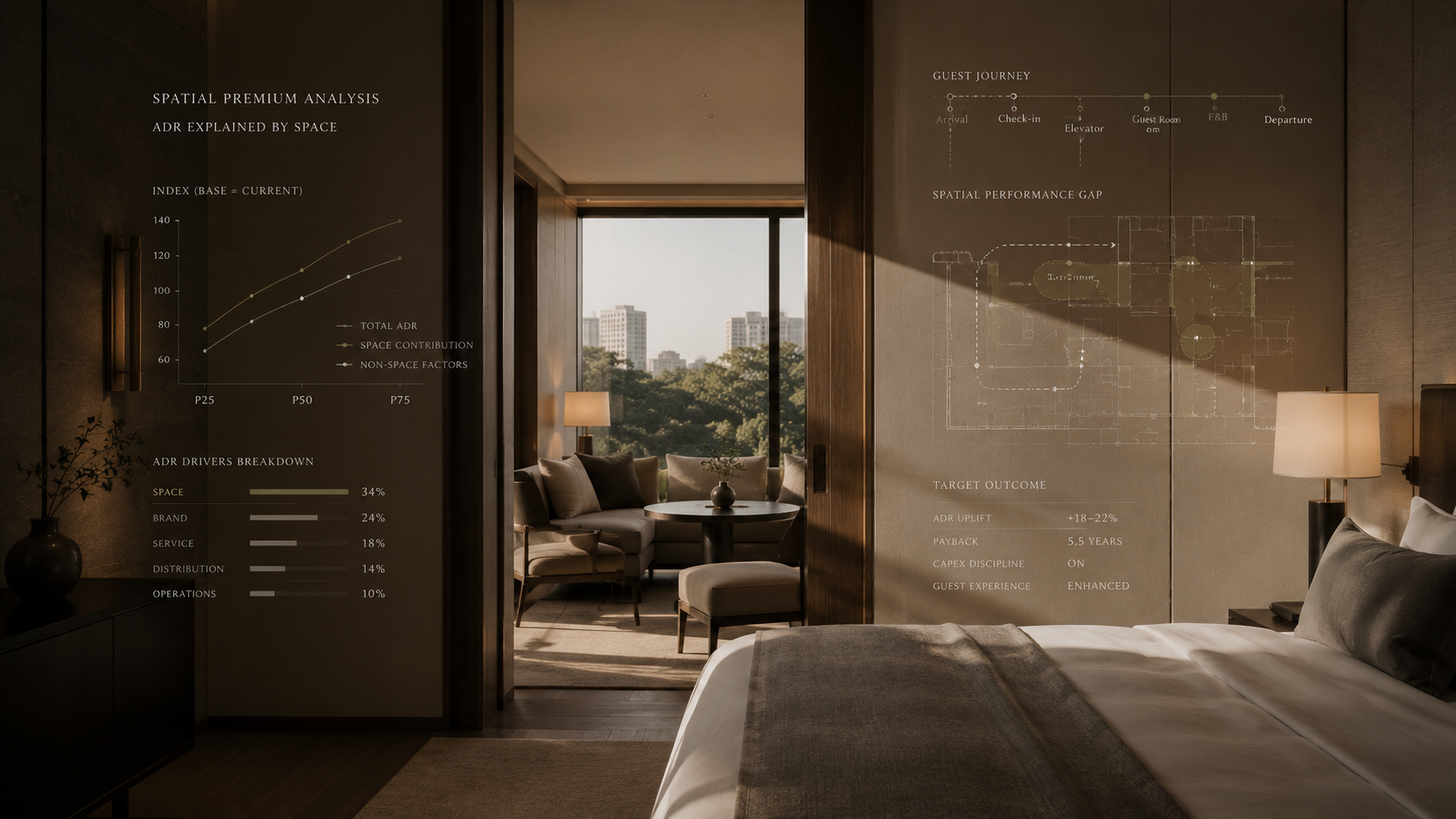
Luxury hotels are sold on spatial experience. The rates are justified, in large part, by what the space feels like. And yet very few operators have a rigorous answer to the question: how much of our ADR is the space earning?
Why the question is rarely asked
The answer is hard to isolate. ADR reflects service, reputation, location, brand, distribution, and space simultaneously. Untangling the spatial contribution requires a methodology — and most operators don't have one, or haven't had cause to build one.
That changes when a renovation is on the table. Suddenly the question becomes financially material: we are about to spend ¥800 million on this property. What return should we expect? How much of that return comes from a higher ADR? And how much of a higher ADR can we actually attribute to the renovation?
At that point, the absence of a spatial performance methodology is expensive. Operators make renovation decisions on the basis of intuition and comparables — which properties feel similar, what their rates are, what they spent. This is not unreasonable in the absence of better data. It is, however, a bet.
The spatial premium benchmark
Our model begins with a benchmark: what is the ADR premium commanded by properties at this tier, in this market, with demonstrably superior spatial quality?
The framework can draw on publicly available rate data, review analysis, operator records, and appropriately licensed market sources. It is not a precise instrument. Every live investment case should identify the source, vintage, sample, applicability, and confidence of each benchmark rather than presenting a range as universal fact.
The following ranges illustrate the type of hypothesis an investment case might test. They are working examples, not current market benchmarks and not suitable for underwriting:
| Property tier | Market | Spatial premium range |
|---|---|---|
| Ultra-luxury (¥80,000+ ADR) | Tokyo central | 18–26% |
| Luxury (¥35,000–¥80,000 ADR) | Tokyo central | 12–18% |
| Luxury (¥35,000–¥80,000 ADR) | Kyoto | 14–20% |
| Upscale (¥15,000–¥35,000 ADR) | Tokyo central | 8–14% |
| Luxury resort | Japan resort markets | 15–22% |
In a live engagement, any range must be rebuilt from an identified competitive set and documented evidence. It is not the rate increase a renovation will produce. Market conditions, operations, distribution, brand, execution, and the brief all affect the result.
The capture coefficient
In practice, we apply a capture coefficient to the benchmark premium when estimating the revenue impact of a renovation. The coefficient accounts for the fact that not every property will reach the upper end of the benchmark — execution risk, operational factors, and market timing all apply.
The public screening tool applies a 45% capture coefficient as a working assumption. That means: if an indicative benchmark suggests a 20% spatial premium, the screen shows 9% as a captured opportunity for further testing. It is not a forecast. A live engagement must sensitivity-test the coefficient against property evidence and execution risk.
The haircut is deliberate, but conservatism alone does not make an estimate defensible. An ownership group should rely on the result only when the underlying comparables, operating assumptions, capex scope, and sensitivity cases are documented and reviewed.
What the model reveals
The spatial premium model does something simple but important: it gives ownership groups a framework for evaluating renovation proposals.
Without it, a designer presents a concept and the owner evaluates it aesthetically. With it, there is a financial question: does this concept — given the guest journey it creates, the dwell time it supports, the revenue-generating moments it enables — justify the premium we have modelled?
The designer is not used to being asked this question. Most cannot answer it. That is not a criticism — it is not their job. It is, however, a gap. And filling that gap is the function of a commercial design brief.
The Spatial ROI Calculator on this site applies this methodology to your property's specific inputs. The result is an estimate — not a forecast — but it is the right question to ask before a renovation conversation begins.