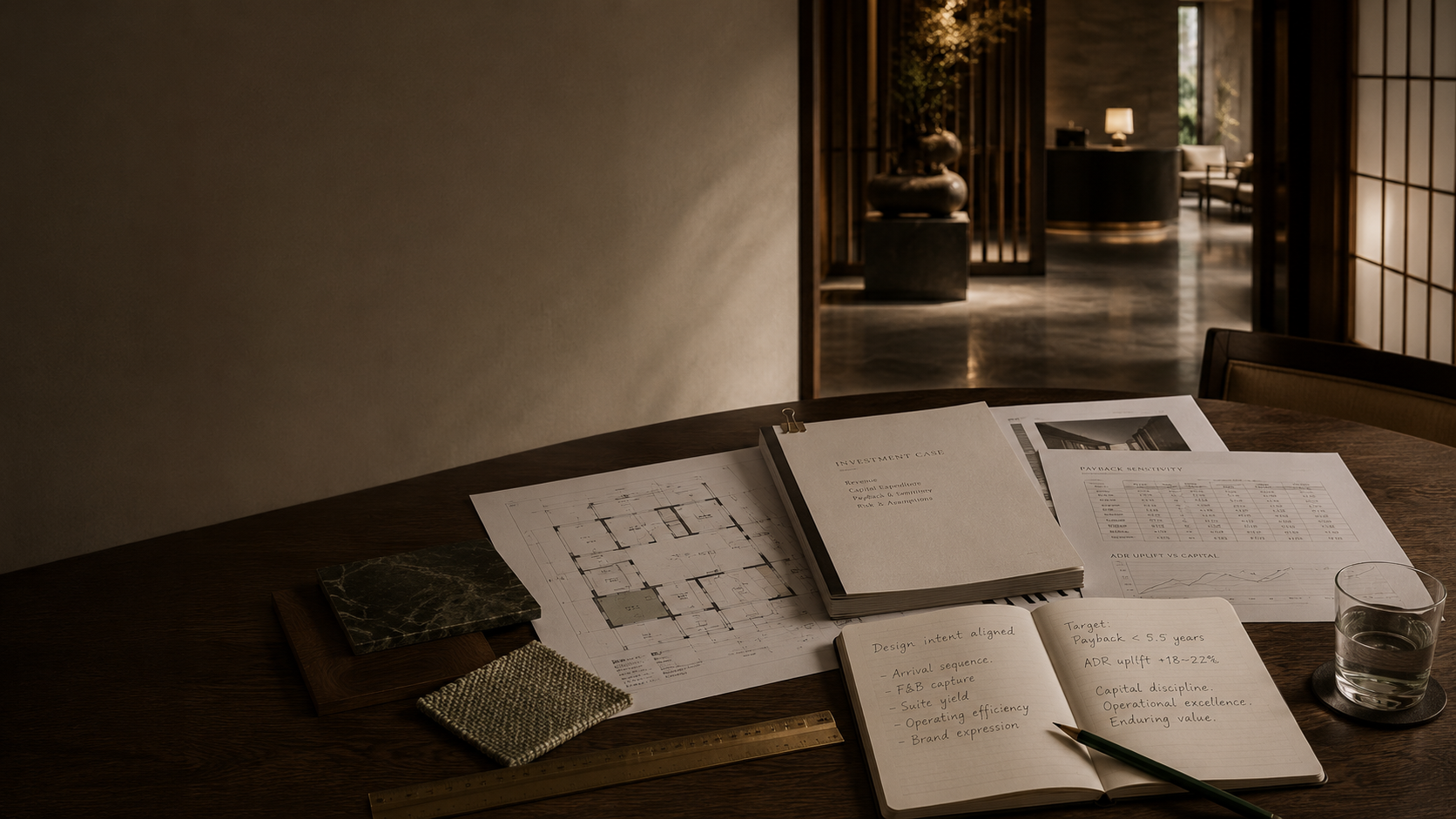
A hotel renovation proposal often reaches ownership with three persuasive objects: a design concept, a capex estimate, and a forecast improvement in performance. The objects may each be credible. The connection between them is usually less clear.
Before approval, an owner should be able to answer five questions.
1. What specific underperformance is the renovation intended to correct?
"The property feels dated" is an observation, not an investment case. The problem should be expressed in measurable terms: an ADR discount to an appropriate competitive set, weak outlet capture, low seat-hour yield, poor conversion of public space, or a brand-positioning gap that can be evidenced in guest behaviour.
If the problem cannot be stated precisely, the project cannot later be evaluated honestly.
2. Which part of the projected improvement is spatial?
ADR and total revenue respond to service, distribution, pricing, brand, market demand, and operations as well as physical space. A renovation case should separate these drivers instead of attributing the full forecast uplift to design.
This does not require false precision. It requires scenarios, explicit assumptions, and a range that the investment committee can challenge.
3. What must guests do differently after the intervention?
A commercial design objective describes behaviour. Guests should notice the outlet from the arrival route. More in-house guests should choose to dine on property. Bar patrons should remain through a second service period. The room experience should support a defined rate position.
These behaviours give the design team something testable. "More luxurious" does not.
4. What evidence would cause us not to proceed?
A serious screen includes a stopping rule. The market premium may be too small. The outlet problem may be operational rather than spatial. The capex required to correct circulation may exceed the plausible revenue gain. Planning, structure, or brand standards may remove the highest-value option.
Discovering that a renovation should not proceed is a valuable outcome of early analysis.
5. How will the commercial case survive design development?
Approval is not the end of the investment case. Design development and value engineering introduce hundreds of decisions that can weaken it one compromise at a time.
The owner needs a commercial brief, acceptance criteria, a decision record, and an independent review process. Otherwise the team can deliver the approved aesthetic while quietly losing the approved outcome.
Portier's Renovation Opportunity Screen frames these questions before an owner commits to a full investment case or design process.